

Mon - Fri:
730am - 430pm
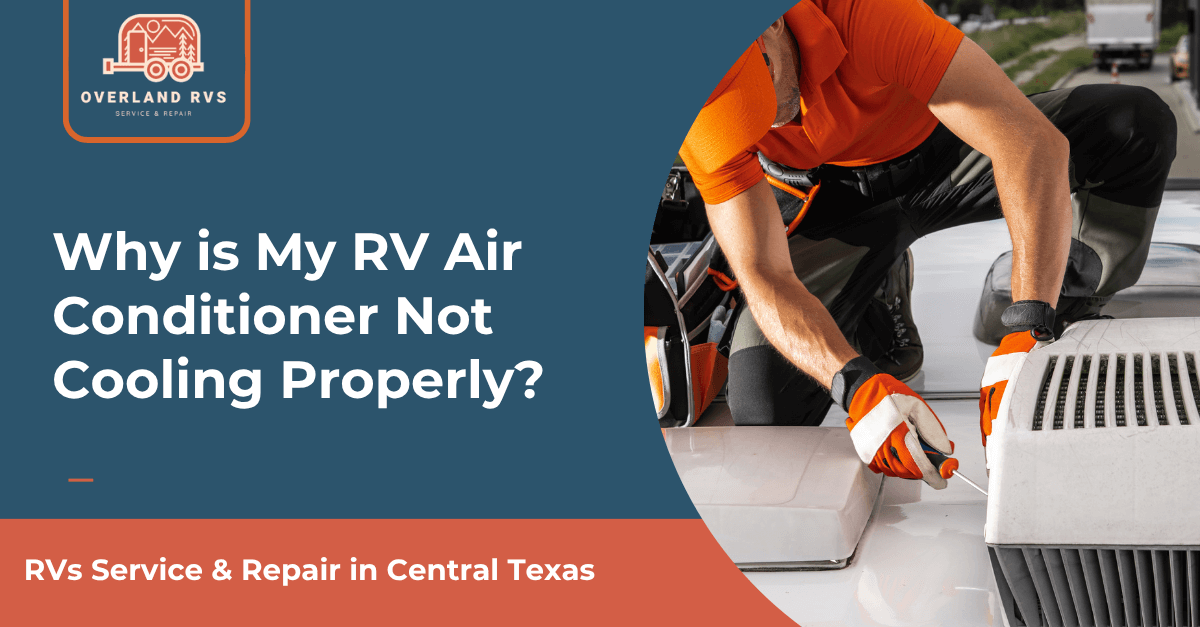
According to an RV Industry Association survey, around 28 million Americans showed interest in RVing this spring. They’re adopting the RV lifestyle, especially the Gen Z generation (71%) in their desire to escape the busyness of life and enjoy off-road adventures.
But your fun trip can turn into an inconvenience real quick with a failing air conditioner, prompting you to find a reliable RV service in Austin, TX. But you first need to understand why your RV AC might not be cooling, some common fixes, and when to reach out to a professional. Let’s discuss all that and more.
All of the above-mentioned problems can affect the proper working of your RV air conditioner. Let’s discuss them in detail to see how you can fix them and when you need professional RV services in Austin, TX.
Dirty air filters are the most common reason behind improper cooling of your RV air conditioner. So first of all, clean them, as it does make a difference in improving the air flow. Otherwise, you not only have to suffer through less cooling in your RV, but the indoor air quality will also be affected.
How to Fix? Cleaning air conditioner filters is very easy. You can do it on your own. Check if the air conditioner is powered off before you locate and pull out the air filters. Wash them with water and leave them to air dry before you install them back. And you must at least do this once a month.
Another very common reason for your RV AC not cooling properly is clogged vents. So inspect those rectangular grilles with slats for any visible signs of dust, stains, or marks. Also, observe if there’s a musty odor coming from the vents, as microbial growth on RV vents can also clog them.
And as per the EPA, if you see visible signs of mold growth inside the ducts or on other components of your heating or cooling system, you must clean it.
How to Fix? First, confirm the air conditioner is switched off. Then, wash off the plastic vent covers, and dry them with a clean towel before you attach them with a clean towel. Do not forget to clean the inside of the vent box too. We suggest cleaning the vents every time you clean the air conditioner filters. This way you’ll ensure a good air flow inside your RV.
The air passageways in an RV AC that carry air to the vents could be leaking, if your air conditioner is not blowing cool air. And if that’s the case, these leaky ducts are also making your system work significantly harder.
How to Fix? Turn on the HVAC fan in your RV AC and feel the ductwork up and down for leaking air. Once you spot the gap or the hole, turn off the fan and apply special metallic foil tape over the leakage. This will save much energy and lower the cooling costs.
You will most likely fix the cooling issue by cleaning both coils. Condenser and evaporator coils of an RV air conditioner absorb and release heat. But when they get dirty, the system needs to work harder and it also produces less cool air.
How to Fix? First, turn off the AC before you start cleaning. Then, uncover both the indoor section and the outdoor section of your RV’s air conditioner individually to clean the evaporator coil and the condenser coil. Use a soft brush to clean the dust and then, follow this with a coil cleaner.
Allow the cleaner to sit for some time. Finally, wash it off.
Your RV air conditioner won’t cool properly, if there’s ice on the evaporator coils or water is dripping around the indoor section. This indicates frozen evaporator coils.
How to Fix? Mostly if you clean the air filters, vents, and the ductwork, it’ll fix the evaporator coils. But if the problem persists, low refrigerant and other complicated issues could be the reason. In that case, you need to hire professional Austin RV services.
Voltage at campgrounds can sometimes drop as low as 90-100 volts (ideal range is 110-120 volts), causing your RV air conditioner to not cool properly. Austin RV services suggest checking the power at the campground before you settle.
How to Fix? First of all, turn off other high-voltage machines in the RV to cut the load on the system. If this doesn’t work. Check if all the wiring is secure, and attach any loose or disjointed linkages. Next, reset the breaker and inspect if the system works smoothly now.
Otherwise, you can also get an AVR (Automatic Voltage Regulator) installed to raise the voltage to its stable levels, if you use that specific campground often.
An incorrect thermostat reading can also be the reason behind your RV AC not cooling properly. So, before getting into more elaborate inspections, double-check your thermostat reading.
How to Fix? Calibrate your thermostat. Or if wiring is the issue, fix it with the help of RV service in Austin, TX. Moreover, for a battery-powered thermostat, change its batteries.
Around 15 percent of both new and operational air conditioners are frequently undercharged. This, along with the leakage, results in low refrigerant levels. And when the refrigerant level is low, an RV air conditioner doesn’t work properly to cool your camper.
How to Fix? Professionals from RV services in Austin, TX, will check your system for any refrigerant emissions, seal them, and refill the refrigerant to its standard amount. Symptoms like higher energy bills, hot air from the vents, or loud noises from the outdoor unit, signals towards low refrigerant levels.
However, if the above-mentioned fixtures don’t work, you can always call professional RV services in Austin, TX, for help. At Overland RVs, we offer top-notch in-house and mobile RV repair services. Call 512 886 9040 to book an appointment or schedule technician visit for mobile RV repairs.
An RV air conditioner typically lasts 5 to 15 years, depending on usage, maintenance, and climate. In hot regions like South Texas, where units run nearly nonstop for 3–4 months, a Coleman Mach 13,500 BTU rooftop AC can expect a 5–8 year lifespan. With regular filter cleaning, voltage protection, and coil maintenance, some units exceed 10 years of service.
Factor | Effect on Lifespan | Typical Lifespan Range | Maintenance Tip |
Light seasonal use (cool climates) | Minimal wear | 10–15 years | Clean coils annually |
Continuous summer use (hot climates) | Heavy wear | 5–8 years | Add soft-start module, clean monthly |
Poor voltage or dirty filters | Accelerated failure | 3–6 years | Use surge protector, replace filters |
High-quality units (premium build) | Extended service | 8–12 years | Inspect capacitors and gaskets |
A properly maintained high-quality RV AC, like a Coleman Mach 13,500 BTU, can stay reliable for nearly a decade, even under Texas heat.
There could be a lot of reasons behind the improper cooling of your RV air conditioner. For example, it could be dirty air filters, coils, or the vents. In fact, low voltage or a malfunctioning thermostat can also affect the air conditioner’s cooling. But the good news is this can be fixed with some troubleshooting.
Whether you need someone to fix RV AC issues, service the system for better performance, recharge the refrigerant, or replace it with a new one, Overland has top-tier technicians for safe handling of the AC system. Call 512 886 9040 to book an appointment or schedule technician visit for mobile RV repairs.
An RV air conditioner may not get cold enough due to low refrigerant, dirty filters, blocked vents, or weak airflow from a failing capacitor or compressor. Clean the air filter, check for frost on coils, and test voltage to ensure the compressor engages properly.
Yes, most RV air conditioners can need recharging if they use a sealed refrigerant system that leaks over time. However, many rooftop RV units are factory-sealed and not designed for recharge. If refrigerant leaks, replacing the entire unit is often more cost-effective.
You can tell if an RV AC is low on Freon by weak cooling, longer compressor cycles, or frost on the evaporator coils. Warm air or hissing sounds also indicate leaks. A certified technician can confirm low refrigerant using pressure gauges.
A bad RV AC compressor shows signs such as clicking without cooling, tripped breakers, or no voltage draw when powered. The compressor may hum or fail to start even though the fan runs. Testing continuity and amp draw helps confirm compressor failure.
A bad RV AC capacitor causes weak starts, fan-only operation, or a humming sound without cooling. If the unit starts after manual fan spinning, the capacitor is likely failing. Testing with a multimeter for capacitance below rating confirms replacement needs.